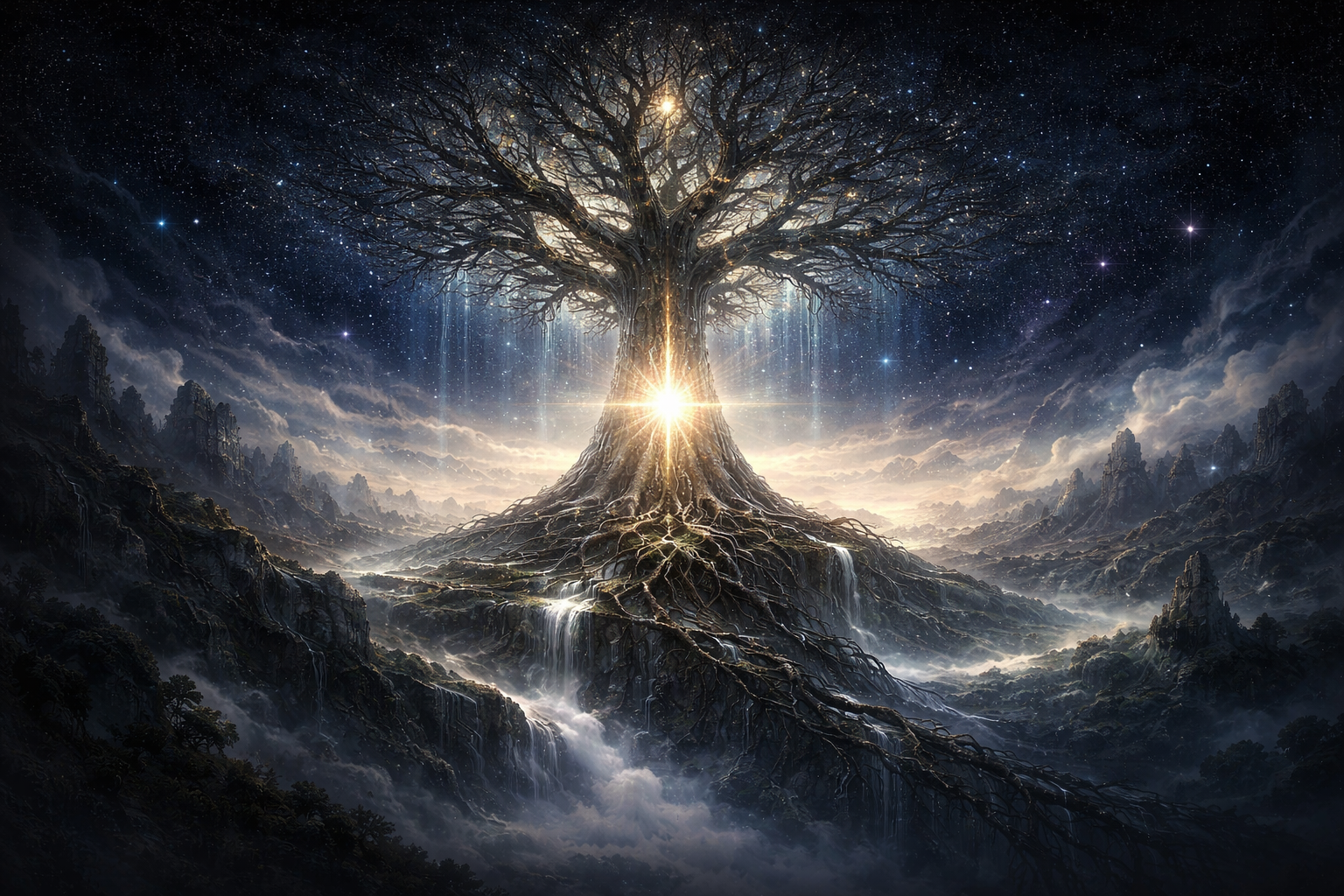
Cosmology Model
Simulation ontology and implementation framework based on the ASH Model of the Universe
Yggdrasil Engine is built on the ASH Model of the Universe. The engine cosmology defines the structural logic of simulation, state, perception, pattern emergence, and consequence. It is a framework foundation rather than a fixed setting, allowing game designers to implement their own lore, mythologies, factions, gods, and world narratives on top of the underlying system.
Cosmology as System Law
The engine cosmology is not a fixed game setting or a single canonical mythology. It is a cosmological implementation framework based on the ASH Model of the Universe — a simulation ontology that defines the structural logic of state, perception, pattern emergence, and consequence.
This is a framework foundation, not a setting bible. Game designers build their own lore, mythologies, factions, gods, histories, and world narratives on top of the underlying system. The game branch of this site shows one such implementation: Where Ravens Wait: Eternal Reckoning Lore.
The ASH Model of the Universe
The ASH (Archetype-Symbolic-Harmonic) Model is the mathematical and ontological foundation of the engine’s simulation layer.
Archetype Layer
Defines the fundamental symbolic patterns that drive procedural generation. Archetypes are structural constants — they describe the shape of meaning, not any specific mythology.
Symbolic Layer
Maps archetype patterns to narrative and simulation events. The symbolic layer translates abstract cosmological state into content the player can experience.
Harmonic Layer
Ensures cosmological consistency across all generated content. The harmonic layer resolves conflicts and maintains structural coherence across the simulation.
Default Structural Realm Framework
The engine provides a default structural realm framework consisting of nine cosmological state layers. These layers function as simulation constants that govern how entities, events, and narratives are generated and classified. They are not locations in a fictional world — they are implementation categories within the simulation ontology.
The default realm layers range from a high-archetype state (pure pattern, no manifestation) through ascending layers of materiality and awareness to a dissolution state (entropy, structural decay). Every generated entity carries a realm attunement that determines its behavior, perception model, and narrative function.
What is fixed is the structural relationship model between these layers — not one required fictional presentation. Implementations may rename, reskin, and narratively reinterpret the realm framework to fit any game setting. The simulation ontology must remain stable for procedural generation to stay consistent, but the thematic expression is entirely up to the designer.
Engine Cosmology Supports
Procedural Generation
Quests, artifacts, creatures, civilizations, and mythologies are generated from ASH cosmic pattern state — not from random templates.
Pattern-Driven Quests
Quest generation follows cosmological state through pattern detection and agent interpretation. Every quest supports multiple completion paths.
Perception Systems
The world state remains constant — perception diverges per agent. Multiplayer-safe narrative variation based on realm attunement and cosmic state.
Myth Emergence
Significant simulation events become mythology within the world, influencing future generation — books, songs, cult beliefs, shrine inscriptions, world rumors.
Prophecy Activation
Prophecies are generated from ASH state and activate when cosmological conditions are met — they are system events, not scripted triggers.
World-State Logic
The engine maintains a unified cosmic state that drives all subsystems. No content exists outside the cosmological state model.
Dual-Variable Alignment Model
The engine baseline includes a supported dual-variable alignment model — a paired system of complementary simulation variables that influence perception, quest generation, and narrative branching. This is not a morality system. Both variables grow through the same event. The model functions as a non-moral simulation variable governing balance-driven consequences.
This is a supported implementation model in the Yggdrasil Engine baseline. Designers may adapt or remap it to any analogous thematic system in their own game settings — light/dark, order/chaos, creation/entropy — as long as the underlying dual-variable balance logic is preserved. The engine preserves the structural logic, not necessarily one mandatory thematic skin.
Lineage Resonance Model
The engine baseline includes a supported lineage resonance model that tracks inherited cosmological attunements across generations of entities. This is a simulation-level mechanic — it governs how realm attunement, alignment variables, and mythic potential propagate through lineage within the simulation.
This is a supported implementation model. Designers may implement this as ancestry, inheritance, faction legacy, or any other lineage system appropriate to their game setting. The structural propagation logic is preserved; the thematic expression is up to the designer.
Designer Extensibility
The engine cosmology is designed to be extended, not replaced. Designers working with the Yggdrasil Engine can:
- Define their own lore and mythic narratives
- Create custom mythologies, pantheons, and creation stories
- Design their own factions, cultures, and civilizations
- Name their own gods, spirits, and cosmic entities
- Write their own histories and world timelines
- Build any setting that respects the structural ontology
The engine provides the cosmological framework. The game provides the world.
See how Where Ravens Wait: Eternal Reckoning implements this cosmology: Game Lore →
Looking for the flagship RPG? Explore Where Ravens Wait: Eternal Reckoning →